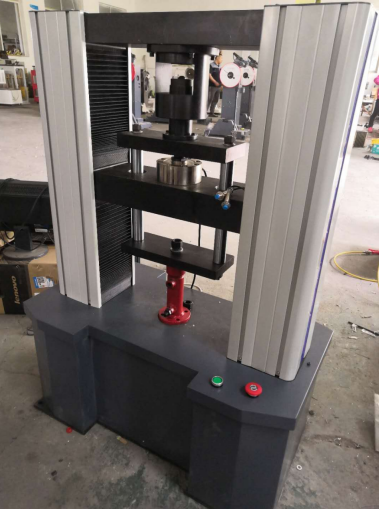
Mechanical testing of fasteners typically refers to tests on bolts and nuts. Bolt tests include tensile fracture (or proof load) tests and wedge load tests, while nut tests usually involve proof load tests (tension or compression proof load). Bolt/nut tensile testing machines are primarily used for the mechanical performance testing of bolts, nuts, standard parts, and fasteners. They can accurately measure the tensile strength and yield strength of bolts, standard parts, and fasteners, as well as the maximum load-bearing capacity of threads, nuts, and bolts, the maximum deformation of the bolt at failure, and ensure the tests comply with the GB/T228-2021 testing method and standard. These machines are suitable for mechanical performance testing of bolts, nuts, standard parts, and fasteners, accurately detecting tensile strength, yield strength, bolt tensile strength, wedge load, and nut proof load tests.
Fastener mechanical testing typically involves testing bolts and nuts. Bolt testing includes bolt tensile fracture (or load-holding) tests and wedge load tests, while nut testing usually involves load-holding tests under tension or compression. Bolt/nut tensile testing machines are primarily used for mechanical performance testing of bolts, nuts, standard parts, and fasteners. They can accurately measure the tensile strength, yield strength, thread and head load capacity, and maximum deformation of bolts under failure. These tests comply with the GB/T228-2021 testing method and standards, and are suitable for evaluating the mechanical properties of bolts, nuts, standard parts, and fasteners, including tensile strength, yield strength, wedge load of bolts, and proof load testing of nuts.
GB/T 3098.1-2010 Mechanical properties of fasteners—Bolts, screws and studs GB/T 2611-2007 General technical requirements for testing machines GB/T 16491-2008 "Electronic Universal Testing Machines" GB/T 13634—2008 "Calibration of Standard Force Transducers for the Verification of Uniaxial Testing Machines" JB/6146—2007 "Extensometer—Technical Specifications" GB/T 228.1-2021 Metallic Materials—Tensile Testing at Ambient Temperature GB/T 7314-2005 Metallic Materials—Compression Testing Method GB/T 8653-2007 Metallic Materials—Method of Test for Young's Modulus, Chord Modulus, Tangent Modulus, and Poisson's Ratio (Static Method) GB/T 16825.1-2008 "Testing of static uniaxial testing machines - Part 1: Verification and calibration of force-measuring systems for tensile and/or compressive testing machines"
Maximum test force (kN): 1000
Relative error of test force indication: ≤ ±1% of the indicated value
Test force resolution (kN): 0.01
Maximum tensile test space (mm): 650
Maximum compression test space (mm): 550
Piston stroke (mm): 200
Diameter of round specimen held by jaws (mm): Φ13-Φ40
Flat sample jaw clamping thickness (mm): 0-30
Maximum clamping width for flat specimens (mm): 70
Clamping plate size (mm): φ160
Maximum distance between two points in bending test (mm): 450