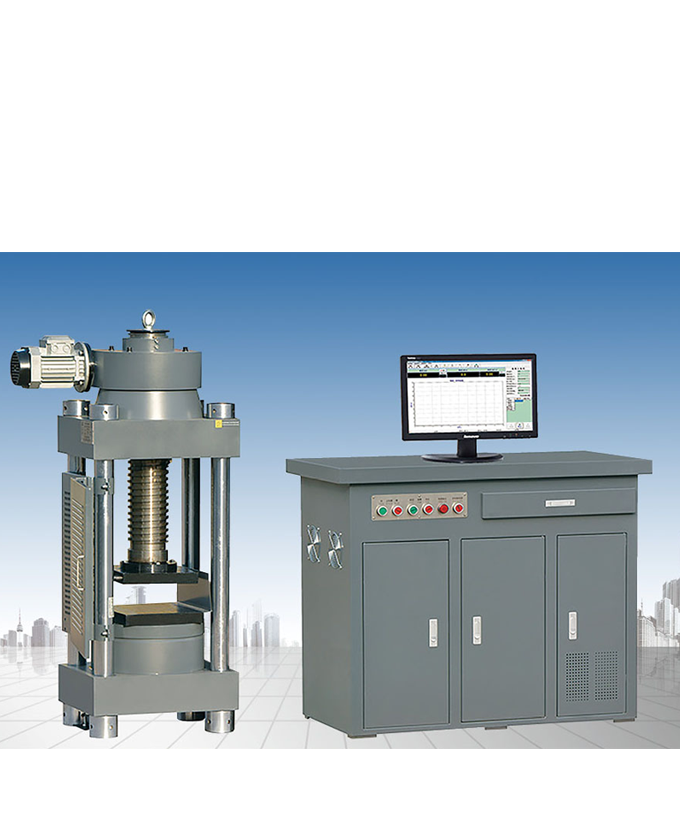
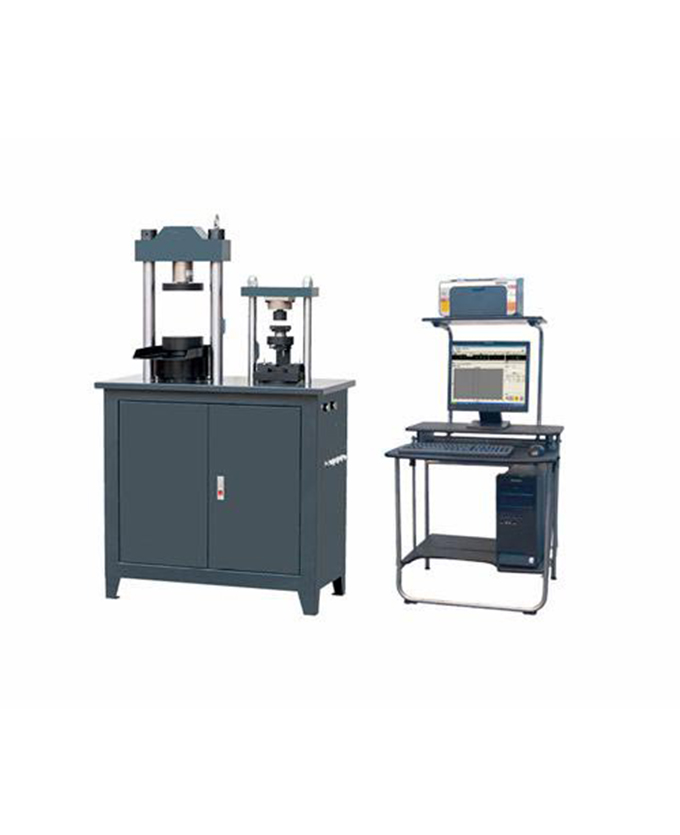
The YAW-5000 fully automatic pressure testing machine is a high-tech, versatile automatic pressure testing system that integrates modern mechanical, electrical, and hydraulic technologies. It is primarily used to test the compressive strength (resistance to pressure) and the stability of physical properties under constant load for various types of bricks, blocks, cement products, hollow bricks, S-bricks, paving bricks, cement bricks, quay bricks, refractory materials, engineering materials, and stones. It is particularly designed for testing products with concrete strength grades C60 and C80.
The YAW-5000 fully automatic pressure testing machine is a high-tech, versatile automatic pressure testing machine integrating modern mechanics, electronics, and hydraulics.Mainly detects compressive strength and physical stability under constant load of various bricks, blocks, cement products, hollow bricks, S-bricks, paving bricks, cement bricks, dock bricks, refractory materials, engineering materials and stone. Especially suitable for testing concrete products with strength grades C60 and C80.
Applicable industries:Widely used in laboratories across industries such as highways, railways, bridges, construction, building materials, and higher education institutions.
Functional Features
The measurement and control system adopts a high-precision digital servo valve with force closed-loop control capability, enabling constant load rate or constant stress rate loading. It offers high control accuracy, reliable performance, and uses a microcomputer for electronic measurement and automatic completion of compression strength tests, including automatic calculation and report printing. It is widely used in the construction industry and testing organizations.
Hydraulic system
Hydraulic oil from the tank is pressurized by a high-pressure pump driven by an electric motor and then flows through a check valve, high-pressure filter, differential pressure valve group, and servo valve before entering the cylinder. The computer sends control signals to the servo valve to adjust its opening and direction, thereby controlling the oil flow into the cylinder and achieving constant test force control.
Force measurement system
Adopts a high-precision amplifier and A/D converter, with no range switching throughout the process, and displays load, peak value, loading speed, and strength in real time;
Constant speed loading is achieved using a PID closed-loop control strategy, with the loading curve displayed in real time.
Automatic interval timing and continuous testing;
Querying and printing test results is flexible and convenient;
Safety protection device
When the test force exceeds the maximum test force3%In case of overload, the oil pump motor will shut down.
Applicable standard:
GB/T 2611-2007 "General Technical Requirements for Testing Machines"; GB/T 2611-2007 "General Technical Requirements for Testing Machines";
JB/T 7406.1-1994 "Testing Machines—Terminology—Material Testing Machines"; GB/T 16825.1-2008 "Testing of static uniaxial testing machines - Part 1: Verification and calibration of force-measuring systems for tensile and/or compressive testing machines"; JJG 139-2014 "Tensile, Compression, and Universal Material Testing Machines"; JB/T 6147-2007 "Packaging, Packaging Marking, and Technical Requirements for Storage and Transportation of Testing Machines"; Main Technical Specifications
Name
Parameters
Maximum test force (kN)
5000
Test Force Measurement Range
5%-100%
Relative error of test force indication
±1% of reading
Distance between upper and lower pressing plates (mm)
330 (customizable)
Piston stroke (mm)
150
Column spacing (mm)
500
Clamping plate size (mm)
500*500
Main unit dimensions (mm)
900*600*1600
Oil source external dimensions (mm)
1050*560*1000
Motor Power (kW)
1.5
Total weight (kg)
Approximately 2600
Software Introduction:
Test software: capable of data acquisition, processing, analysis, storage, and display. User Management: Allows creating and editing users, with dual permission management functionality. Control method: Manual control. Powerful analysis and processing capabilities: Users can select common curves (stress-strain, load-deformation, load-time, load-displacement, displacement-time, deformation-time, etc.), perform local magnification (stepless zoom without levels), traverse, move the center point, automatically identify characteristic points (elastic segment, yield point, etc.), overlay multiple curves, manually mark, compare results, preview prints, and manually revise data effectively.