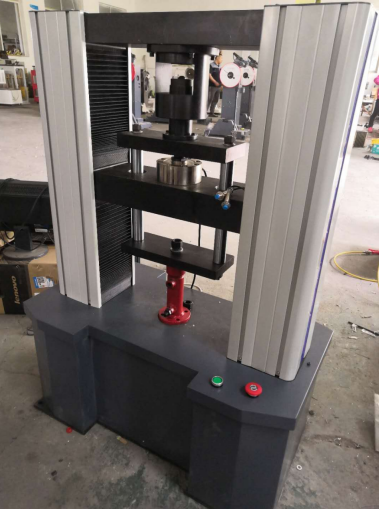
High-temperature creep refers to the phenomenon where materials undergo slow plastic deformation over extended loading times under temperatures T ≥ (0.3~0.5)T_m (where T_m is the melting point, and the temperature is T) and stresses well below the yield strength. It is used to test the creep properties and stress rupture strength of various metals and alloy materials in high-temperature environments, evaluating performance parameters such as the creep limit and stress rupture strength limit.
High-temperature creep refers to the phenomenon where materials slowly undergo plastic deformation over time under temperatures T ≥ (0.3–0.5)Tm (Tm is the melting point) and stresses much lower than their yield strength. It is used to evaluate creep properties and long-term strength of various metals and alloys under high-temperature conditions, measuring parameters such as creep limit and long-term strength limit. Depending on the applied stress method, it can be classified into high-temperature compressive creep, tensile creep, bending creep, and torsional creep. Compared to high-temperature strength, high-temperature creep more effectively predicts strain trends and fracture life of materials under prolonged high-temperature service, making it an important mechanical property closely related to material composition and structural characteristics.
Main features of the high-temperature creep testing machine: 1. The cylindrical high-temperature furnace has high working efficiency, up to dozens of times that of traditional split-type high-temperature furnaces. It allows sample replacement and repeated testing without cooling down, heating up, or insulation processes. 2. The electric system controls the vertical movement of the high-temperature furnace, while the linear guide ensures safety, stability, and concentricity between the sample and the furnace chamber. 3. Electric lifting cylindrical high-temperature furnace, operators do not need to come into contact with the furnace, significantly reducing labor intensity while ensuring safety and reliability; 4. The cylindrical high-temperature furnace offers excellent thermal insulation, a long uniform temperature zone (200 mm), and a maximum temperature of 1200°C. The electric furnace has a long service life, ensuring 30,000 hours of operation at temperatures up to 1200°C. 5. The cylindrical high-temperature furnace has excellent safety performance, operating on a low safety voltage (25V) with high current supply, eliminating any risk of electric leakage and meeting international safety standards; 6. The outer surface temperature of the cylindrical high-temperature furnace is low. Imported thermal insulation material ensures the furnace surface temperature remains below 90°C (at 1200°C), ensuring safe operation. 7. Equipped with fully digital AC servo drivers and high-precision, high-response-frequency AC servo motors, ensuring fast frequency response and high positioning accuracy; 8. Equipped with manual pressure release adjustment, effectively protecting the machine, especially the load sensor, in case of unexpected power failure.
Technical specifications:
Test force
300 kN (optional)
Testing Machine Class
0.5
Test Force Measurement Range
1%-100%
Test force resolution
1/200,000 of the maximum test force (full-scale resolution remains unchanged)
Relative error of test force indication
±0.5%
Relative variability of test force indication
±1.5%
Test force resolution
1/100000
Upper and lower jaw eccentricity
≤10%
Speed of the pull rod movement
0.01-100mm/min
Pull rod travel
200mm
Manual uninstallation mechanism
The system is equipped with a manual adjustment mechanism, which can be used to unload in case of unexpected power failure, effectively protecting the machine and test samples.
Power supply
AC380V±10%;50Hz
Electric furnace and temperature control system
High-temperature furnace type
Split-type muffle furnace (three-section), electric wire heating
Operating temperature range
200~1100℃
300~1100℃
Length of the constant temperature zone
200mm
150mm
Furnace dimensions
Φ90mm
External dimensions
Φ350×500mm (can be adjusted according to user requirements)
Heating element (resistance wire)
Use HREΦ5mm heating tubes
Uses a 1mm diameter furnace wire
Electric furnace service life
Continuous operating time at ≤1200°C exceeds 30,000 hours.
Electric furnace table temperature (average)
At 1200℃, ≤90℃; at 700℃, ≤50℃
Electric furnace lifting method
The electric lifting mechanism raises and lowers the electric furnace, and can be manually operated when power is off.


 Technical specifications: