

Load Compression Test Fixture (ASTM D6641)

As shown in Figure 1, the CLC fixture consists of two pairs of steel blocks, each pair clamped together with four bolts. During installation, the ends of the 5.5-inch-long specimen are flush with the ends of the blocks. The gripping surfaces of the steel blocks are 1.2 inches wide and are used to test specimens with a nominal width of 1 inch.
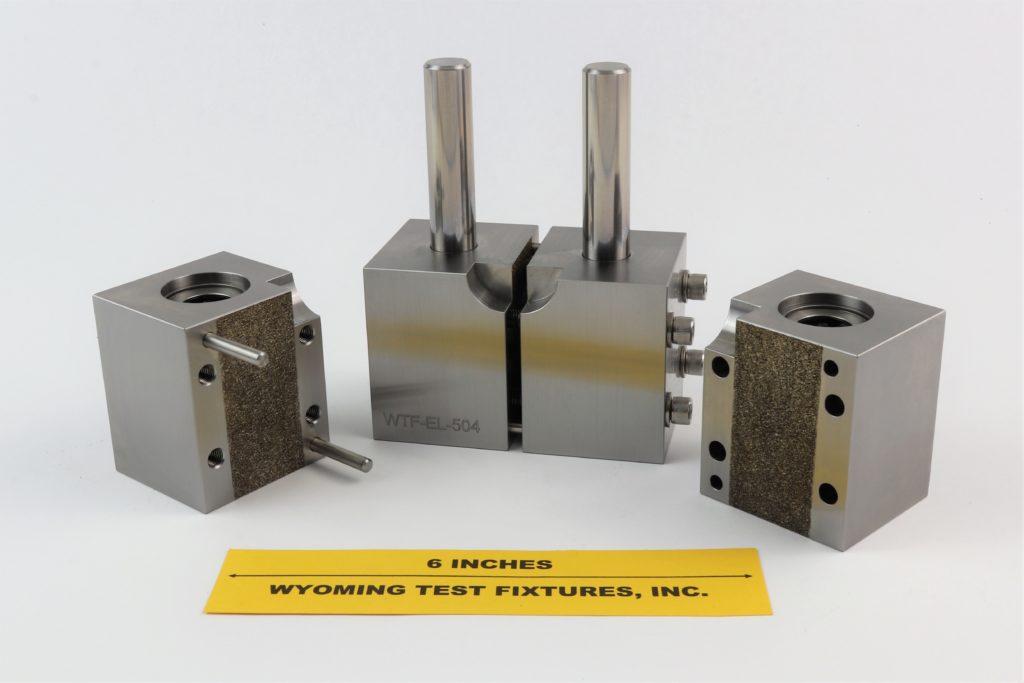
As shown in Figure 2, these gripping surfaces are coated with tungsten carbide particles to enhance friction, thereby allowing higher shear loads to be transferred to the specimen. Moreover, since these surfaces are relatively smooth (100 grit), they do not damage the specimen's surface. This enables the use of unsanded specimens in many applications, which is a significant advantage in terms of specimen preparation costs.
By adjusting the bolt torque, the ratio of end load to shear load on the specimen can be controlled, meaning that combined loading can be achieved. This allows successful testing of materials that are stronger under pure end loading (avoiding end crushing) while requiring less clamping force than pure shear loading (reducing stress concentrations caused by clamping).
The fixture blocks also prevent severe bending of the specimen. Two alignment rods in linear bearings are used to maintain the alignment of the upper and lower pairs of fixtures, with the linear bearings eliminating friction from the alignment rods. A circular groove on one side provides clearance for an edge-mounted extensometer, if used. Alternatively, bonded strain gauges can be applied to one or both faces of the specimen.
The fixture with the installed specimen is placed unrestrained on the flat base of the testing machine and is loaded directly on its top surface by a flat platen attached to the testing machine's crosshead.
