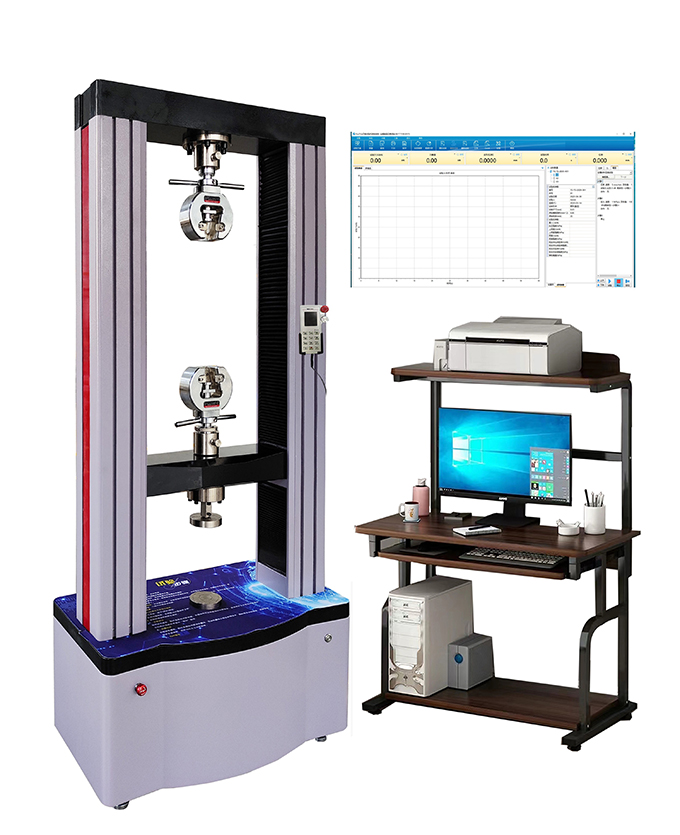
Microcomputer-controlled Universal Testing Machine for Wood-based Panels
The microcomputer-controlled universal testing machine for wood-based panels is capable of testing and analyzing various mechanical performance indicators of plywood, particleboard, medium-density fiberboard, and other wood-based panels as well as their surfaced versions. This product is widely used in the wood processing industry and wood-based panel manufacturing enterprises.
Product Performance Features
The microcomputer-controlled universal testing machine for wood-based panels can test and analyze various mechanical properties of different wood-based panels such as plywood, particleboard, and medium density fiberboard (MDF), as well as surfaced wood-based panels. This product is widely used in the wood deep-processing industry and wood-based panel manufacturing companies. According to Chinese national standard GB/T17657-2013 "Test methods for physical and chemical properties of wood-based panels and surfaced wood-based panels," the specialized software of the testing machine can automatically calculate data and parameters from various tests, including internal bond strength, bonding strength, static bending strength, modulus of elasticity, screw-holding force, and surface bonding strength. The computer control system ensures that the testing process and data processing meet the requirements of relevant national standards for metallic and non-metallic materials. Test reports can be generated in various formats, such as WORD and EXCEL.
This machine is pollution-free, low-noise, and highly efficient, with a wide speed adjustment range. It is suitable for material testing and analysis in various industries such as plywood, particleboard, and medium-density fiberboard, making it an ideal testing equipment for scientific research institutions, colleges, industrial and mining enterprises, technical supervision, and commodity inspection arbitration departments.
Product Performance Features
This testing machine is manufactured according to the Chinese standards GB/T 2611-2007 "General Technical Requirements for Testing Machines" and GB/T 16491-1996 "Electronic Universal Testing Machines." It complies with various national and international standards including GB, ASTM, and others. The machine features an attractive design, convenient operation, and stable, reliable performance.
The microcomputer-controlled universal testing machine for wood-based panels produced by our company integrates advanced foreign control technology, elegant appearance design, an efficient transmission system, high-performance AC servo motor, high-precision servo driver, and ball screw to form a high-performance mainframe. The control system adopts the popular high-speed PCI 2.2 standard parallel bus design. It uses amplifiers from U.S.-based BB Company, high-speed analog-to-digital converters and CPLD from AD Company to form a data acquisition system, and high-precision load sensors constitute the measurement system. The software is written in the widely used C#.NET high-level language, allowing simple and fast upgrades.
Main Technical Specifications
Maximum test force: 10 kN
Accuracy Level: Grade 1
Structural form: Portal frame structure
Permissible error limit of test force indication: within ±1% of the indicated value
Load measurement range: 2% to 100% of full scale
Force resolution: 1/300000 of maximum test force
Limit error of displacement indication: Within ±1% of the indicated value